
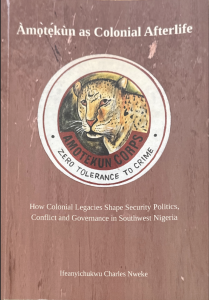
Nigeria has long grappled with insecurity, forcing communities to respond, often through so-called vigilantes. This perspective is tempting when analysing Amotekun, which Yoruba governors established in Southwest Nigeria on 9 January 2020. However, drawing on multi-site ethnography and novel Amotekun Court archives, this dissertation contends that Amotekun is not just another Nigerian vigilante group. Instead, it is better understood as a contemporary manifestation of Nigeria’s colonial experience—a Colonial Afterlife. Àmọ̀tẹ́kùn as Colonial Afterlife foregrounds its historic nature and transformative impact—the first time a Nigerian ethnic group has established a security organisation to serve its own community. As a result, Amotekun alters the Nigerian security architecture by extracting security autonomy from the postcolonial state for the Yoruba. This shift presents risks and opportunities. Risks include ethnic instrumentalisation, as shown by Miyetti Allah, the Fulani herders’ association, reproducing its externally imposed threat profile, which the dissertation calls internalised securitisation. Conversely, Amotekun moves Nigeria closer to fulfilling the long-held ambition for decentralised security governance, often called state police. Therefore, maximising the benefits of Amotekun depends on carefully reducing its risks while enhancing its societal advantages. Beyond Nigeria, Amotekun offers insight into the wider transformation of security governance across the postcolonial world, where indigenous groups are demanding and securing degrees of autonomy from the postcolonial state.
Àmọ̀tẹ́kùn as Colonial Afterlife recognises that in multi-ethnic postcolonial societies, autonomy to determine what constitutes a threat is just as important as, or more important than, protection from those threats. Amotekun thus reshapes the very idea of security—as participation.
PhD dissertation by Ifeanyichukwu Charles Nweke, Institute of Security and Global Affairs, Leiden University (2026).